3D Printing and Laser Scanning: Gimmick or the Only Way to Save Orphan Marques?
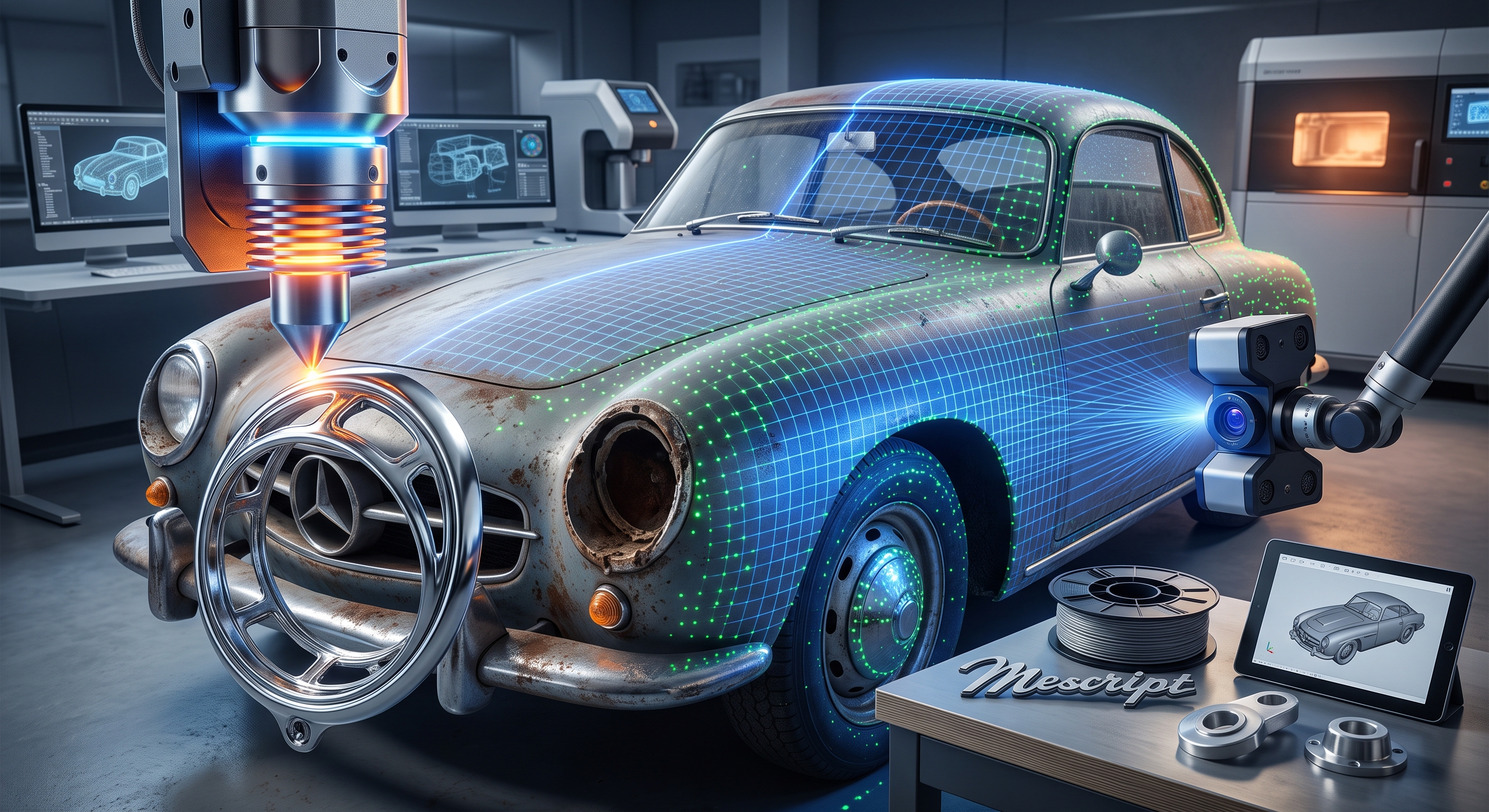
For custodians of pre-war rarities and obscure European orphan marques—from Facel Vega and Bizzarrini to forgotten Tatra or Delahaye streamliners—the greatest barrier to preservation has never been mechanical enthusiasm, but sheer material attrition. When original tooling dies, factory archives vanish, and swap meets run permanently dry, securing New Old Stock (NOS) trim ceases to be a scavenger hunt and becomes a statistical impossibility. For decades, missing exterior brightwork or shattered Bakelite bezels relegated irreplaceable machinery to perpetual static displays. Today, however, high-resolution metrology and additive manufacturing are transforming vintage restoration from an exercise in compromise into an exact science.
Key Takeaways
- Affordable vintage beauty
- Simple mechanics, easy to maintain
- Iconic design, recognizable
- Wide parts availability
- Great for restoration projects
The Extinction of NOS Trim: The Orphan Marque Dilemma
When an automotive manufacturer closes its doors, its intellectual property and tooling rarely survive intact. For high-volume classics like early Ford Mustangs or air-cooled Porsches, robust aftermarket ecosystems sustain production through fresh stampings and licensed reproductions. Conversely, orphan marques produced in hand-beaten runs of hundreds, rather than tens of thousands, offer zero economies of scale for traditional commercial tooling. A missing cast-bronze badge, a cracked fluted glass taillight bezel, or an asymmetrical fender spear cannot justify a six-figure progressive stamping die.
Restorers historically faced two grim alternatives: cannibalizing another survivor car or commissioning one-off coachbuilding artisans whose hammer-forming and hand-machining, while masterly, demand hundreds of billable hours per trim piece. Even then, replicating complex compounded interior switchgear, delicate script badges, and hollow extrusions by hand often introduces discrepancies in fit and finish. Without a scalable, digital middle ground, rare marques risked irreversible bastardization or permanent mothballing.
High-Resolution Laser Scanning: Capturing Ghosts in 3D
The restoration pipeline no longer begins with calipers and clay, but with non-contact optical metrology. Blue-light 3D scanners and handheld laser systems capture dense point clouds with tolerances under 10 microns, enabling restorers to digitize degraded originals directly on the vehicle chassis. This capability eliminates the risk of warping fragile, age-brittle zinc or pot metal during disassembly. Furthermore, when only one side of an asymmetric assembly survives—such as a solitary left-hand side-spear—scanning software mirrors the volumetric data to generate an exact digital twin for the missing opposite side.
Raw scans, however, capture every dent, stone chip, and pitting artifact sustained over an eight-decade lifespan. This is where modern reverse engineering proves vital. Digital sculptors import mesh geometry into parametric CAD environments, extracting curvature flows and parting lines while stripping away wear patterns. Restorers can re-establish original design intent, thickening failure-prone bosses, embedding concealed mounting hardware, and standardizing thread profiles without compromising the visible exterior styling.
Additive Manufacturing vs. Gimmick: From Prototyping to Functional Metal
Skeptics often dismiss 3D printing in classic motoring as a prototyping gimmick limited to brittle PLA or cosmetic display mockups. While entry-level filament printing is indeed inadequate for exterior brightwork, modern industrial additive manufacturing has bridged the gap to structural, heat-resistant, and electroplateable automotive components. Stereolithography (SLA) with ceramic-filled resins and Selective Laser Sintering (SLS) utilizing carbon-fiber-reinforced polyamides yield interior knobs, vent trim, and lens housings that withstand extreme cockpit cabin heat without deforming.
For exterior brightwork requiring mirror chrome, the technology branches into two formidable pathways: Direct Metal Laser Sintering (DMLS) and additive investment casting. DMLS utilizes fiber lasers to fuse micron-thin layers of stainless steel, bronze, or aluminum powder into fully dense, machinable metal parts. Alternatively, high-precision wax resins can be printed directly and transferred into ceramic shell molds for traditional bronze or brass lost-wax casting. The resulting metal castings are subsequently chased, hand-polished, and triple-chrome-plated via copper, nickel, and decorative chromium, rendering them indistinguishable from hand-finished factory originals.
Setting Up In-House Additive Workflows: Cost vs. Independence
Until recently, acquiring the equipment necessary for industrial digitizing and metal printing required institutional-level capital expenditure. Today, a hybrid in-house strategy allows independent restoration shops to eliminate external delays. By pairing professional-grade structured-light scanners (retailing in the four-to-five-figure bracket) with high-definition resin SLA printers, shops can test-fit dimensionally accurate prototypes on-site within hours, iterating clearances against original coachwork before locking in final specifications.
Once physical test validation is complete, workshops can export clean STEP files to specialized contract manufacturing bureaus for final additive DMLS or lost-wax casting runs. This hybrid framework eliminates tooling investment, shortens restoration schedules from years to weeks, and ensures that the digital blueprints remain indefinitely archived in the shop's private registry. If an orphan marque strikes road debris at a vintage rally, replacement trim is merely a print command away.
Conclusion: The Digital Safeguard for Motoring Heritage
Far from being a passing novelty or a lazy shortcut, digital reverse engineering and additive manufacturing represent the definitive lifeline for the world's most vulnerable historic vehicles. By detaching component availability from archaic supply chains and extinct tooling, these advanced technologies restore mechanical autonomy to custodians and restoration specialists alike.
Preserving orphan marques is fundamentally about honoring engineering heritage without surrender to obsolescence. As metrology hardware and additive metallurgy continue to mature, the gap between impossible unobtanium and a pristine, concours-ready assembly has dissolved into a stream of digital code—ensuring the rarest icons of the open road remain driven rather than forgotten.
Leave a Comment
Comments
No comments yet. Be the first to share your thoughts!